Corporate Tax and E-Invoicing: What Bahrain Small Businesses Should Do Before 2027 

Two changes are on the horizon for businesses in Bahrain: a proposed corporate income tax, and mandatory e-invoicing. Neither is final yet, and it’s easy to either panic or ignore them. 

There’s a calmer approach. The steps that prepare you for both are the same steps that make your business easier to run today. 

The proposed corporate income tax: what we know 

  • Proposed: a 10% tax on company profits, targeted to start in January 2027. 
  • Threshold: as announced, it would apply to companies with annual revenue above BHD 1 million or net profit above BHD 200,000 — and only to profit above BHD 200,000. 
  • Status: it is a draft, not law. It was referred to the legislature in December 2025, and in May 2026 a parliamentary committee raised concerns that put it under further review. 

For most small businesses, the proposed thresholds mean no tax would be due. But being below a threshold is something you show with accurate accounts. Clean, reconciled books are how you demonstrate where you stand, whatever the final law says. 

E-invoicing: what we know 

The National Bureau for Revenue is preparing a mandatory e-invoicing system. Details and start dates haven’t been published. Regional experience, such as Saudi Arabia’s rollout, suggests a phased start, likely beginning with larger taxpayers. 

What it will almost certainly mean: invoices issued in a structured electronic format from a proper system, not typed up in Word or Excel. Businesses already invoicing from accounting software will have far less to change. 

What to do now 

  1. Move to monthly bookkeeping if you’re not there yet. It’s the foundation for tax, VAT and funding. 
  1. Know your real profit, not just your revenue. Monthly management reports make this routine. 
  1. Invoice from accounting software. It’s the single biggest step toward e-invoicing readiness. 
  1. Keep records organised and retrievable, including invoices, contracts and bank statements. 
  1. Plan your year-end now. Most businesses close on 31 December. Starting in October means December is just another month. 

Software is included with our package 

Every Capital Profits monthly package includes the Odoo Accounting module at no extra cost, set up and used by our team to keep your books. If you’d rather use Tally, Sage 50, QuickBooks or Microsoft Dynamics 365 Business Central, we can supply and set up those as a separate purchase. 

That means one affordable monthly fee covers your bookkeeping, VAT and reporting, plus the software to run it — and a CPA-led team watching for what changes in 2027. 

Talk to us about your books. Call +973 17281717 or email info@cpaccounts.com. 

Can AI Do Your Bookkeeping? What It Gets Right, and What It Doesn’t

Ask founders in Bahrain how they use AI and most will have an answer: drafting emails, writing proposals, summarising contracts. More and more, the next question is whether it can do the books too. 

The honest answer: a lot of the work, and faster than ever. But not the part that carries the risk. 

What AI already does well 

  • Reading documents. Photograph a supplier bill or receipt, and accounting software can pull out the supplier, date, amount and VAT in seconds. 
  • Matching bank lines. Modern systems suggest which invoice a payment belongs to, and learn from the matches you confirm. 
  • Sorting routine spending. Rent, utilities, subscriptions: the same transactions every month are easy to predict. 
  • Answering quick questions. A chatbot can explain what an accounting term means or how a report is laid out. 

This is real progress. Work that used to take an afternoon of data entry now takes minutes. Odoo Accounting, the module included in our monthly package, already does much of this. 

Where it goes wrong 

AI is good at patterns. Bookkeeping is mostly patterns until it isn’t. 

  • It sounds sure even when it’s wrong. A general chatbot can give you a VAT answer that reads well but is out of date, or based on another country’s rules. Bahrain has its own thresholds, invoice requirements and deadlines. 
  • It doesn’t know your business. Is that payment a shareholder loan, a customer deposit or revenue? Is that new laptop an expense or an asset? The answer changes your profit and your VAT, and it depends on facts only you and your accountant know. 
  • It can’t see what’s missing. Software processes the invoices it’s given. It won’t notice that a supplier stopped sending them in August. 
  • Nobody signs it off. Your business is responsible for its VAT return, whichever tool helped prepare it. 

Be careful what you paste 

Uploading bank statements, payroll or customer lists into a free AI chatbot means handing that data to a third party. Bahrain’s Personal Data Protection Law (Law No. 30 of 2018) covers personal data about your staff and customers. Before you share anything financial, check where the tool stores data and whether it uses your uploads to train its models. 

The records still have to exist 

However the numbers are produced, the evidence behind them has to hold up. The NBR now requires VAT records and accounting books to be kept for 10 years. An AI summary isn’t a record. The invoices, receipts and reconciliations are. 

The setup that works 

The businesses getting the most from AI aren’t replacing their accountant with a chatbot. They use both: 

  1. Let software do the capture: scanning bills, importing bank transactions, suggesting matches. 
  1. Have a qualified person review it every month, not once a year. 
  1. Keep one system of record. Proper accounting software, not a mix of spreadsheets and chat history. 
  1. Take tax questions to someone accountable for the answer. 

That’s how we work for our clients. Odoo handles the repetitive work, and our CPA-led team checks it, reconciles it, files your VAT and tells you what the numbers mean. 

Run your business. Not your books. Talk to us about your books: call +973 17281717 or email info@cpaccounts.com.
Q3 VAT Return in Bahrain: What to Check Before You File 

If your business files VAT quarterly, your return for July to September is due by 31 October 2026. That’s a Saturday this year, so in practice you want it done well before the weekend. 

Most VAT problems aren’t dramatic. They’re small gaps in the records behind the return, repeated every quarter until someone looks closely. Here’s what to check before you submit. 

1. Reconcile sales to your invoices 

The output VAT on your return should match the VAT on the invoices you actually issued. Check that every sales invoice for the quarter is recorded, that credit notes are included, and that nothing from June or October has slipped into the wrong period. 

2. Check your input VAT claims 

You can only reclaim VAT on business costs that qualify, and only when you hold a valid tax invoice. Common slips include: 

  • Claiming VAT on expenses that aren’t eligible, such as some entertainment costs 
  • Claiming from a receipt instead of a proper tax invoice 
  • Claiming from suppliers who aren’t VAT-registered, so no VAT was actually charged 

3. Make sure your invoices meet the requirements 

The National Bureau for Revenue (NBR) updated its general VAT guidance in 2026, including more detail on what a tax invoice must show — for example, a clear description of what was supplied. If your invoices come from a Word or Excel template, compare them against the current guidance. 

4. Look at imports and unusual transactions 

Imports, capital purchases and one-off sales often need different treatment. If anything out of the ordinary happened this quarter, check it before it goes on the return. 

5. File early and keep the records 

Submit through the NBR portal ahead of the deadline, pay on time, and keep the working papers behind the return. VAT records must now be kept for 10 years, so store them where you can find them. 

Do you need to register for VAT at all? 

If you’re not registered yet, this is worth checking now. In Bahrain: 

  • Registration is mandatory once your taxable supplies exceed BHD 37,500 in the last 12 months, or are expected to in the next 12 months. 
  • Voluntary registration is possible from BHD 18,750. 

The test runs on a rolling 12 months, not the calendar year. A growing business can cross the line mid-year without noticing, and late registration brings its own penalties. 

If this felt like a lot 

That’s normal. VAT is one of the main reasons small businesses in Bahrain come to us. We prepare and file our clients’ returns ahead of the deadline as standard, from reconciled books, as part of one affordable monthly package that includes the Odoo Accounting module. 

See where your numbers stand. Call +973 17281717 or email info@cpaccounts.com, and we’ll tell you plainly whether you need to register, and how we’d handle your VAT every quarter.

Can’t Afford an Accountant? Your Options as a Small Business in Bahrain 

If you run a small business in Bahrain, you’ve probably had this thought: I know my books should be done properly, but I can’t justify hiring an accountant. 

You’re not wrong. A full-time accountant is a salary, social insurance, a desk and a laptop — before they’ve recorded a single invoice. For a business with a handful of staff, that rarely adds up. 

But “we can’t afford an accountant” often turns into “nobody is really looking after the books.” That gets expensive in quieter ways. Here are the realistic options, and what each one actually costs you. 

Option 1: Do it yourself 

Many founders start here, with a spreadsheet and a folder of receipts. It costs nothing up front, and it works while the business is tiny. 

The cost shows up later: 

  • Your time. Hours every month that could go into sales, customers or rest. 
  • Errors that compound. A missed invoice or a wrongly claimed expense isn’t a problem until it’s twelve months of them. 
  • VAT risk. If you’re VAT-registered, your returns are only as accurate as the records behind them. 
  • A painful year-end. Reconstructing a year of transactions in December is slower, more stressful and more expensive than keeping them up monthly. 

Option 2: A part-time or freelance bookkeeper 

This can work well, especially with someone experienced. The risks are continuity and coverage. If they’re unavailable during a VAT deadline, or they move on, your records leave with them. And a bookkeeper who records transactions isn’t always the person who can answer a VAT question or prepare statements a bank will accept. 

Option 3: Hire in-house 

The right answer eventually, for many businesses. For a company of 1–20 people, it usually means paying for a full-time role to do part-time work. 

Option 4: An outsourced monthly accounting package 

You pay a fixed monthly fee, and a firm keeps your books, prepares your VAT returns and produces your reports. You get a team rather than one person, so deadlines don’t depend on someone’s leave or availability. 

For most businesses that can’t justify an in-house hire, this is the option that fits: proper, compliant books at a fraction of what a full-time salary costs. 

Why getting this right matters more in 2026 

Your books now decide more than your tax. Since June 2026, Bahrain classifies businesses as micro, small or medium partly by annual turnover. That classification affects which Tamkeen programmes you can apply for. Banks and funders ask for up-to-date accounts, too. The number at the start of all of that comes from your bookkeeping. 

What to look for in an affordable accounting service 

  • A clear monthly scope that tells you exactly what’s included — no surprise charges at year-end. 
  • Qualified oversight. Ask who reviews the work, and what their credentials are. 
  • VAT included, not bolted on as an extra. 
  • Software. You shouldn’t have to buy a separate system just to get started. 
  • Responsiveness. You should get an answer from a person, not a ticket number. 

How we do it at Capital Profits 

We’ve handled monthly bookkeeping and VAT for Bahrain startups and small businesses since 2019. The work is led by a Certified Public Accountant, and our monthly package includes the Odoo Accounting module at no extra cost. It’s built for exactly the business this article is about: one that needs its books done right, but can’t justify an accountant on the payroll. 

Run your business. Not your books. Talk to us about your books: call +973 17281717, email info@cpaccounts.com, or use the contact form on this page. 

7 Signs Your Business Needs Professional Accounting Services in Bahrain

Running a successful business requires more than generating sales. Behind every growing company is a strong financial foundation that supports informed decision-making, healthy cash flow, and sustainable growth.

Many SMEs in Bahrain initially manage accounting internally. While this may work during the early stages, increasing transactions, VAT obligations, employee costs, and operational complexity often create financial management challenges.

Professional accounting services help business owners maintain accurate records, gain financial clarity, and stay compliant with Bahrain’s regulatory requirements.

Here are seven signs that your business may benefit from professional accounting support.

1. You’re Spending Too Much Time on Financial Administration

How many hours each week do you spend:

  • Preparing invoices?
  • Recording expenses?
  • Following up on customer payments?
  • Organizing receipts and documents?

Every hour spent on accounting tasks is time taken away from growing your business.

Professional accounting support allows business owners to focus on customers, sales, and operations while experienced professionals manage the financial records.

2. You Don’t Have Clear Visibility of Business Performance

Can you answer these questions immediately?

  • What was your net profit last month?
  • Which expenses increased this quarter?
  • How much cash is available today?
  • Which customers generate the highest revenue?

Many business owners make decisions based on assumptions instead of real financial data.

Professional accounting services provide timely financial reports that help business owners understand performance and make informed decisions.

3. Your Bookkeeping Is Not Updated Regularly

Delayed bookkeeping often causes:

  • Inaccurate financial information
  • Difficulty tracking income and expenses
  • Missed business opportunities
  • Increased risk of accounting errors

Accurate and up-to-date bookkeeping is the foundation of every successful business.

Regular bookkeeping ensures your records remain organized, reliable, and ready whenever needed.

4. VAT Compliance Has Become Challenging

VAT compliance is now an important responsibility for businesses operating in Bahrain.

Businesses must maintain accurate documentation, retain supporting records, and submit VAT-related information correctly and on time.

Common challenges include:

  • Incorrect VAT calculations
  • Missing supporting documentation
  • Incomplete record keeping
  • Lack of VAT process controls

Professional VAT support helps businesses reduce risk and improve compliance with Bahrain’s VAT requirements.

5. Your Business Has Grown but Your Accounting Process Has Not

Business growth is exciting, but it also increases financial complexity.

As your company grows, you likely have:

  • More transactions
  • More employees
  • More suppliers
  • More customers
  • Greater reporting requirements

The accounting process that worked when your business was smaller may no longer provide the control and visibility you need.

Professional accounting services help ensure your finance function grows alongside your business.

6. You Need Better Financial Reports for Decision-Making

Financial reports should do more than satisfy compliance requirements.

They should help you understand your business and identify opportunities for growth.

Key reports include:

  • Profit & Loss Statements
  • Balance Sheets
  • Cash Flow Reports
  • Management Reports
  • Budget Performance Reviews

Having access to accurate reports allows business owners to make confident decisions based on facts rather than assumptions.

7. You Need Financial Expertise Without Hiring a Full Finance Team

Building an internal finance department can be expensive for many SMEs.

Outsourced accounting services provide access to experienced professionals at a fraction of the cost of hiring a full accounting team.

This gives businesses:

  • Professional expertise
  • Lower overhead costs
  • Scalable support
  • Better financial controls
  • Improved reporting

Why Bahrain Businesses Choose Capital Profits

At Capital Profits Accounting Services, we help SMEs build stronger financial foundations through:

✅ Professional Accounting Services

✅ Bookkeeping Support

✅ VAT Compliance Assistance

✅ Management Reporting

✅ Outsourced Accounting Solutions

✅ Financial Process Improvements

Our team works closely with business owners to improve financial visibility, maintain compliance, and support smarter business decisions.

Free Accounting & VAT Compliance Consultation

Not sure if your current accounting process is helping or holding your business back?

Book a FREE Accounting & VAT Compliance Consultation .

Contact Capital Profits Accounting Services today and start building a stronger financial foundation for your business.

Announcement of partnership with Defense CyberSecurity

26-Oct-2021

In light of the growing demand on cybersecurity services in the region, we are proud to announce our partnership with Defense Cyber Security in Riyadh, KSA.

Defense Cyber Security is specialized in providing cybersecurity and risk assessment services to the highest standards and are experts in developing and deploying policies and procedures to protect companies from all kinds of risks and cyberattacks.

Moreover, Defense Cyber Security provides internationally accredited cybersecurity trainings and awareness programs to ensure that employees are informed of the best practices to face all sorts of threats and possible data breaches.

This partnership will enable us to better meet our clients’ needs and ensure the highest levels of service.

Should you have any inquiries regarding cybersecurity risk, compliance, governance, or training and awareness services, please don’t hesitate to contact Defense Cyber Security.

Defence Cybersecuirty website: https://dcybersecurity.sa/

THE IMPORTANCE OF ACCOUNTING IN TIMES OF CRISIS

Amidst the current economic slowdown, companies are understandably looking for ways to cutdown on overheads and maintain revenues. Non-core functions such as marketing, HR, or even accounting may be the first to be foregone.  

This article aims to highlight the importance of the accounting function in a company especially in times of crises. In fact, it is in times of economic uncertainty is when the benefits of maintaining accurate accounts pays dividends.  

Know Where to Focus Your Efforts 

Maintaining accurate books of accounts can help companies identify and separate the profit generating functions from loss generating functions. This is never more important than in the times of economic slowdown. This is the type of information that decision makers need to make choices that can ensure the survival of the company. 

Time for a Loan? 

Governments across the world have implemented financial aid packages for companies to get through the current crisis. Some of these packages include loans for companies to ensure that they have sufficient working capital during these difficult times. In order to be able to get such loans however, companies will be required to submit financial statements explaining their financial position and the impact that the COVID-19 Pandemic had on their operations. In such situations, time is of the essence, therefore, preparing such statements at the spur of the moment would take too long. 

The Tax Man Still Wants His Money 

It is necessary for all companies to comply with the tax regulations that are imposed by the government regardless of the economic conditions. If the company’s accounts are not reliable and up to date, tax calculations will inevitably be affected and accordingly, companies might find themselves either paying more or less than what they should putting themselves at risk of penalties either way. Therefore, maintaining accounting records that are in line with the tax regulations can save companies money and protect them from potential penalties.  

Insurance Claims 

Accounting records may be essential for companies to prove ‘lost earnings’ due to the mandatory closure of the businesses or a drastic decrease in business activity. For companies insured against such natural disasters or circumstances such as the current COVID-19 pandemic, it would be wise to maintain accurate and up to date accounting records to support their insurance claims.  

Life After VAT: Now that you are registered, what next?

Life After VAT: Now that you are registered, what next?

vat bahrain

vat bahrain

Well, first of all, congratulations on successfully registering your business for VAT. For most establishments, it might have been a difficult and complicated task especially if your accounting books were not in order ahead of time.

Now that you are registered though, business cannot continue as usual. Being a VAT registered company/establishment essentially means that you are now responsible for handling funds that essentially belong to the government. You are given a great responsibility and are required to rise up to the challenge in order for you to be able to continue doing business in Bahrain – and avoid the hefty penalties.

First things first though, you need to make sure that you are issuing your invoices properly. By that I mean you are issuing your invoices on time and in the proper format while accounting for VAT appropriately. Articles 52 and 53 of the VAT Regulations specify the requirements of “VAT Invoices”. There are essentially two kinds of invoices, the Standard VAT Invoice and the Simplified VAT Invoice. The latter can only be issued in case the product or service has been delivered to a non-registered person or in case the total value of the invoice is less than 500 BD. I encourage you to download the VAT Regulations here and review the requirements yourself. This may mean that you will need to upgrade or even change your accounting or POS systems since not all systems can comply with these requirements. Moreover, some systems can only accommodate for 2 decimal places in the currency which may cause a problem since Article 55 of the VAT Regulations states that VAT calculations must be rounded to the nearest Fils, which is in the 3rd decimal place. In case you need someone to help you assess your systems, look no further than H.A. Consultancies. As far as I know, they are the experts on such matters.

On the other hand, you will need to make sure that your suppliers also give you correct VAT invoices since you will be claiming back whatever VAT you paid them in your quarterly or monthly return. If their invoices are incorrect or not compliant with the requirements of the VAT Regulations, you might find yourself unable to claim back the VAT you paid.

As for issuing the invoices on time, well, that is a bit easier. You have 15 days from the date of performing the service or delivering the product to issue the invoice. However, VAT may be due prior to the date of your invoice since according to the regulations, it is due on the sooner of performing the service or delivering the product, receiving the payment, or issuing the invoice. Therefore, in case you received an advance payment, VAT will be due on that portion of the advance even if you did not deliver the product or service yet. Moreover, VAT is due even if you did not receive a payment from your customer. Therefore, it would be smart to take advantage of the 15-day leeway in case you have delivered a service/product towards the end of a reporting period.

All of this might be overwhelming at first and you might need to get some guidance from a professional accountant (call us in case you need any help). However, once you get your procedures in order, complying with the VAT requirements can induce more stringent control over your business resulting in a maximization of profits and a reduction of losses.


Munther Al-Arayedh, CPA
Managing Director
Capital Profits Accounting Services

Flavors of Accounting

Flavors of Accounting

types of accounting

types of accounting

Just like ice cream, accounting comes in various flavors. There are so many to choose from, sometimes it is difficult to make up your mind.

In reality though, most of these “flavors” are just plain old vanilla, strawberry, or chocolate. Some are a mix of more than one flavor. Others are more like frozen yoghurt (not real ice cream).

Here we will try to shed light on the main accounting types that may have caused some confusion amongst those non-lingo-savvy business owners out there.

Each of these types has a different focus area and different yet intertwined objectives. The main objective of all accounting services is the same though, to provide decision makers with clarity and control over their business operations at all times.

Tax Accounting

Many would agree, Tax Accounting is bittersweet. It deals with taxes such as Income Taxes, Sales Taxes, Value Added Taxes (VAT), Withholding Taxes, and so on.  The objective is to ensure compliance with the applicable tax laws and local regulations to avoid any fines or penalties that may be imposed due to non-compliance. If done properly, Tax Accounting can save the company money. For instance, proper implementation of VAT regulations can save companies from bearing the cost of input tax and hence reduce the VAT liability on the company.

Cost Accounting

Cost Accounting is plain old vanilla. It simply records all the direct and indirect costs that the company endures in order to keep track of all the money leaving the company or those who we owe money. Once we know where all the money goes (or is supposed to go), reports can be generated to help management take better decisions.

Project Accounting

Project Accounting allows companies to track revenues generated and expenses paid and/or accrued for each project undertaken by the company. The objective is obviously to track profitability of each project individually.

Financial Accounting

Financial Accounting is a mix of multiple accounting disciplines. The objective is to simply generate the three main financial statements, the Balance Sheet, Income Statement, and Cash Flow Statement. This can be easier said than done. Financial Accounting is governed by complex standards which are frequently updated to ensure more accurate reporting. Depending on where your business is located, and, in case you have branches, where those branches are located, you might find yourself preparing different sets of financial statements with subtle differences due to the different financial accounting standard being followed. For instance, the USA has its Generally Accepted Accounting Principles (GAAP) while Europe and most of the Middle East follow the International Financial Reporting Standard.

Management Accounting

Management Accounting is the “make it yourself” flavor of accounting. You can pick and choose what to put in it according to your independent needs. The objective here is to identify, measure, analyze, interpret, and communicate financial information to managers, all in order to be able to get accurate decision making. In this type of accounting, you can identify profitable products and services, generate pricing or marketing strategies, detect inefficient processes and improvement opportunities.

Needless to say, this type of accounting can provide significant insight on a company’s performance, however, sadly, it is typically either not performed in a timely manner, drains resources, or simply overlooked.

Public Accounting

When a firm provides accounting services to other companies, it is called a Public Accounting firm – an example of which is our firm, Capital Profits (surprise!). Public Accounting may include financial audits and reviews, outsourced bookkeeping services, financial statement preparation, internal control policies implementation, physical asset and stock counts, analytical reports, tax return preparation, and accounting consultations.

Nowadays, keeping a company’s accounting books in an orderly manner and following all the regulations enforced by the state can be a stressful endeavor for any business. The risks of penalties and fines are high and hiring an accounting team might be unfeasible. Therefore, having a Certified Public Accountant by your side on a retainer basis can help alleviate concerns with regards to non-compliance and allow business owners to do what they do best, run their business.

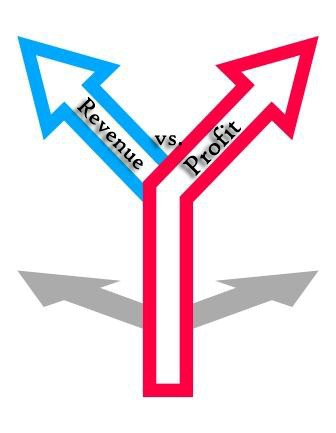
Revenue vs. Profit


Rev vs Pro

Rev vs Pro


Any business owner needs to know how to maximize their profit and to demonstrate to investors that the company is heading in the right path since revenue can indicate a firm’s potential.
The most important difference between revenue and profit is that while any company can increase its revenue, it may well be registering a net loss of earrings at the same time.

Revenue

Revenue means the total amount of money that the company generated through its business activities (in other words, it is the total sales of the company).

Profit

1. Gross profit
It is basically revenue minus cost of goods sold, on the income statement, gross profit appears directly after revenue, it is calculated by subtracting Cost of Goods Sold (COGS) from the total revenue.
As a metric, it is used by business owners to gain an idea of how much money they have with which to fund the business after their core product is produced and sold.

2. Operating Profit
Operating Profit means Gross Profit minus all fixed expenses encountered when you run the business, such as rents, utility bills & payroll. It is used to demonstrate the earning power of any business in terms of its regular operations, removing external factors to show its potential profitability.
Some companies may choose to use Operating Profit over Net Profit to highlight the financial impact of external overheads. For example, investors can use Operating Profit to compare the business with a similar firm operating under a different tax structure.

3. Net Profit
Whenever people start to talk about any firm’s profit, they usually refer to Net Profit which means the remaining income after all the operating costs, debts, expenses, interest and taxes are deducted.
Net Profit is the most important financial metric on the income statement, it is the most important figure to the investors and shareholders.
In terms of Operating Profit, Net Profit can be expressed as Operating Profit minus interest and taxes:
Net Profit = Operating Profit – Interest – Tax

4. Net profit margin
The Net Profit Margin is the ratio of the company’s net income to its revenue, it is presented as a percentage.

Taking all of this into account, a business owner should always try to maximize his Gross, Net, and Operating Profits rather than just increasing sales revenue. Nevertheless, if operating expenses are kept under control, increasing sales revenue might well result in an increase in profits.